What Not to Say in a Maid of Honor Speech (8 Mistakes to Avoid)
You’ve been asked to give a maid of honor speech. You’re honored, maybe slightly terrified, and already deep in a Google spiral trying to figure out what to actually say. Here’s the thing though, knowing what not to say is just as important as knowing what to include. Maybe more.
Every wedding has that one speech. The one where you feel the room shift, where the couple’s smiles go stiff and the moms exchange a look. Don’t be that speech. A maid of honor speech that lands well isn’t just about the right stories, it’s about avoiding the landmines that turn a beautiful moment into the thing everyone’s still whispering about on the drive home … and not in a good way!
After hearing dozens of wedding speeches (and plenty of post-wedding recaps about what went sideways), the same maid of honor speech mistakes come up again and again. Most of them fall into a few predictable categories: oversharing, inside jokes, and stories that somehow manage to leave the couple out entirely. If you’re wondering what not to say in a maid of honor speech, start here.
So before you finalize a single word, run your speech through this. Consider it your last edit before you take the mic.
Quick Answer: What Not to Say in a Maid of Honor Speech?
The biggest maid of honor speech mistakes are mentioning exes, embarrassing the bride, relying on inside jokes, and talking so long the room checks out.
Never mention:
- Exes or past relationships (either theirs or yours)
- Inside jokes only one or two people will understand
- Anything implying the wedding “finally” happened
- Embarrassing stories that cross into genuinely personal territory
- Your own personal drama or life story
- Divorce jokes, not even as a throwaway
- Generic comments that don’t feel personal
- Anything that leaves the groom completely out of it
Here’s why each one goes wrong, and what to do instead.
8 Common Maid of Honor Speech Mistakes to Avoid
1. Exes. Any and All of Them.
This should be obvious, but speeches get written at midnight after a glass of wine, so here’s the reminder: do not mention anyone the bride or groom has dated. Not to be funny. Not as a “we’ve come so far” moment. Not even as a quick one-liner you think will land. It won’t. The couple has moved on. The audience doesn’t need a detour through relationship history, and the couple definitely doesn’t need to hear those names on their wedding day.
The only love story that belongs in your speech is the one standing at the altar.
2. Inside Jokes Nobody Else Gets
You and the bride have a language all your own – that’s the whole point of a best friendship. But a wedding reception is not the place to perform it. Inside jokes that require backstory, context, or a shared experience from 2014 leave the entire room feeling like they walked in on the wrong party. You and the bride might be dying laughing. The groom’s family is just staring at their appetizers.
If a joke needs a three-sentence explanation to be funny, cut it. The best stories pull the whole room in, not just the front table. Give your anecdotes enough background that strangers can both follow along and actually laugh.
3. Anything About the Wedding “Finally” Happening
“I can’t believe it’s finally here!” seems harmless, but that word – finally – carries a weird implication that this took longer than expected. Same goes for “I didn’t think this day would ever come” or “after everything they’ve been through.” Unless you’re intentionally framing a real comeback story in a meaningful way, these phrases plant doubt instead of joy. Stick to language that celebrates the moment rather than commenting on how long it took to get there.
4. Embarrassing Stories That Cross the Line
There’s a real difference between funny-mortifying and actually embarrassing. Funny-mortifying is the story about the time she got so nervous meeting his family that she spilled red wine all over the tablecloth. Actually embarrassing is anything involving her body, her past, her mental health, her lowest moments, or anything she’s shared with you in confidence.
MODERN MOH TIP: Quick gut check: would she be fine with her future mother-in-law, her boss, and her grandmother all hearing it? If there’s any doubt, cut it. That’s the rule.
5. Your Own Life Story
The room is there to celebrate the couple, not to learn about you. A little context about who you are and how you know the bride is totally appropriate. Actually, it’s a must-do. But the speech should not drift into your own relationship history, your anxiety about being single, your career frustrations, or anything that positions you as a main character. Even if your personal journey is genuinely intertwined with hers, keep the lens on her and the relationship. You’re the narrator, not the protagonist.
6. Divorce Jokes
Not even as a throwaway joke. Even if you know they’d laugh. There is genuinely no version of a divorce joke at a wedding that reads as anything other than deeply uncomfortable, and it’s the kind of line that lives rent-free in people’s memories long after the cake is gone. Aim for humor that celebrates the relationship, not hedges against it.
7. Vague, Generic Compliments
“She’s the most amazing person I’ve ever met” is the speech equivalent of a participation trophy. Technically a compliment, but it doesn’t actually say anything. What makes her amazing? What has she done that proves it? Vague praise feels safe but falls completely flat next to a specific, real moment that illustrates the exact same thing.
Instead of “she’s always been there for me,” try: “she drove four hours in a snowstorm to help me move out of my apartment, and she didn’t complain once – except about the mattress, which, fair.” Specific details are what make a speech memorable. Generic ones make it forgettable.
8. Leaving the Groom Out Entirely
Here’s a mistake that happens more often than you’d think: a maid of honor speech that’s entirely about the bride and never once mentions the groom. You were asked to speak because of your relationship with her, yes. But this is a celebration of a marriage, not just a friendship. Even if you don’t know him that well yet, talk about what you’ve seen. How he looks at her. Who she’s become since he came into her life. Include him. People notice when you don’t.
Real Maid of Honor Speech Mistakes People Still Talk About
None of these are hypothetical. They’re the speeches that get retold at brunch years later, for all the wrong reasons.
The speech that mentioned three exes. The MOH thought it was a funny “journey to finding the right one” narrative. It was not. By the third name, the groom’s family had gone completely silent and the bride was doing the smile-and-nod thing that means she’s actually furious.
The speech that ran 15 minutes. It started strong. By minute six, people were discreetly checking their phones. By minute ten, the catering staff had started quietly clearing appetizers. There’s no story good enough to hold a room for 15 minutes. Five is the sweet spot. Eight is the absolute ceiling.
The speech that was entirely inside jokes. The MOH and bride were in hysterics the whole time. The rest of the room, including the groom, had no idea what was happening. The best man later said it felt like watching a private conversation with an audience.
The speech that embarrassed the bride. Oversharing a story that the bride had told her in confidence. The kind of story that changes how people see you. The bride laughed it off in the moment, but brought it up three years later. Some things don’t stay on the wedding day.
The speech that forgot the groom existed. Twelve minutes about their friendship, their college years, their travels together. And then one sentence acknowledging the man the bride was literally marrying. He was standing right there!
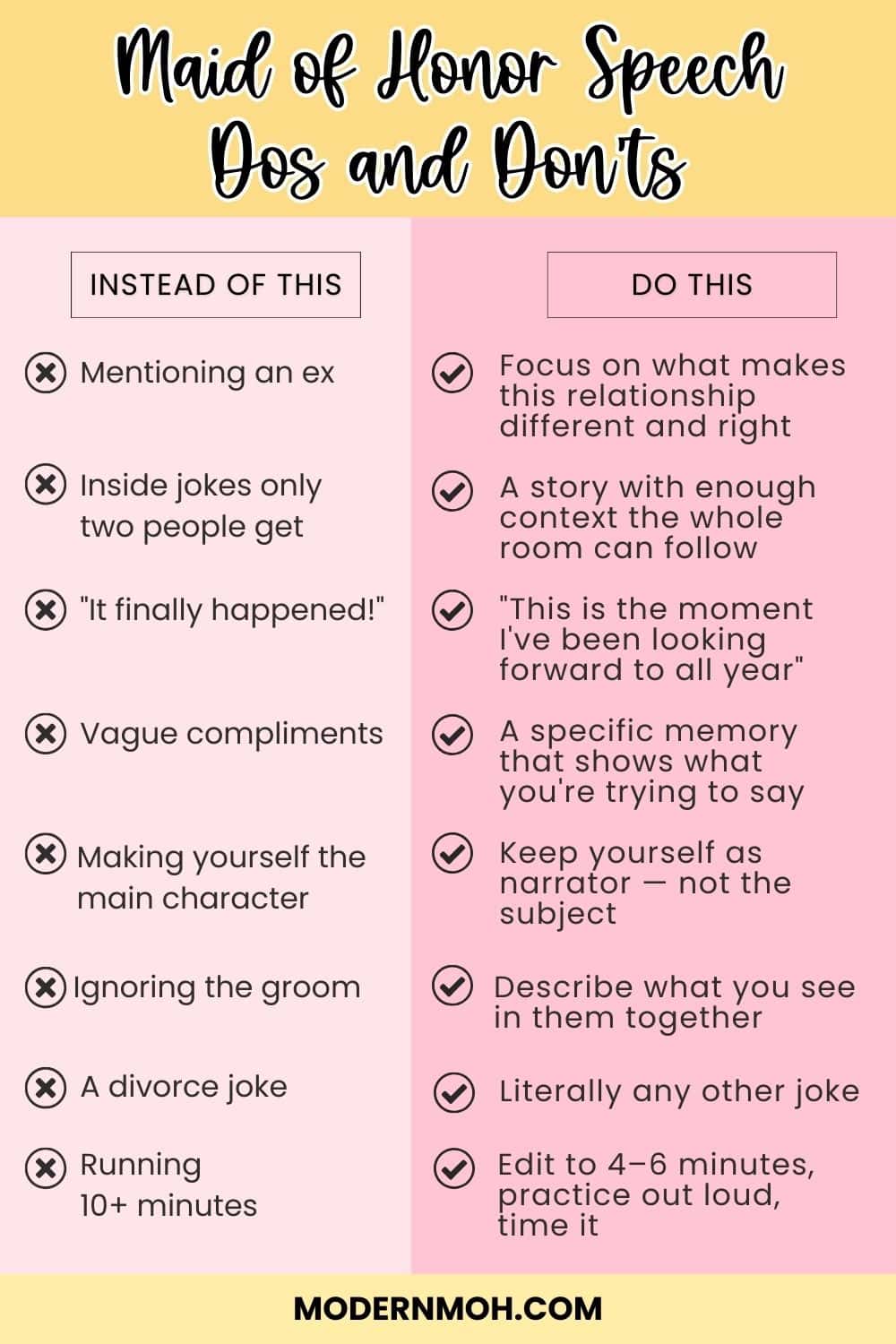
Maid of Honor Speech Dos and Don’ts (Quick Guide)
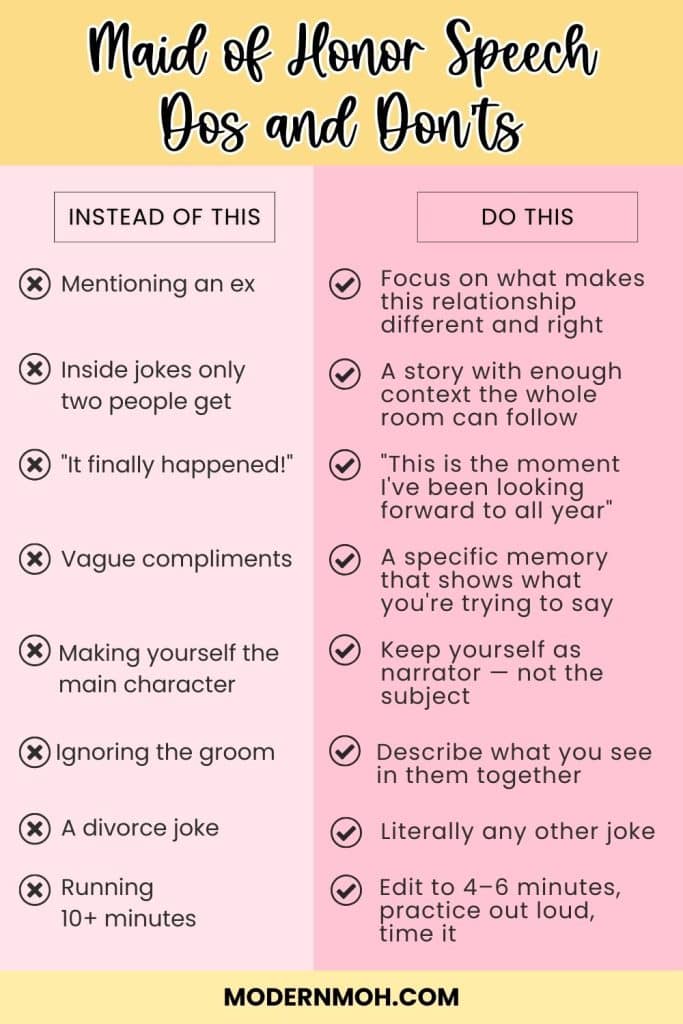
Most maid of honor speech dos and don’ts come down to one thing: keeping the focus on the couple, not yourself. Here’s the short version:
| Instead of this… | Try this… |
|---|---|
| Mentioning an ex | Focus on what makes this relationship different and right |
| Inside jokes only two people get | A story with enough context the whole room can follow |
| “It finally happened!” | “This is the moment I’ve been looking forward to all year” |
| Vague compliments | A specific memory that shows what you’re trying to say |
| Making yourself the main character | Keep yourself as narrator — not the subject |
| Ignoring the groom | Describe what you see in them together |
| A divorce joke | Literally any other joke |
| Running 10+ minutes | Edit to 4–6 minutes, practice out loud, time it |
A Safe Maid of Honor Speech Structure That Always Works
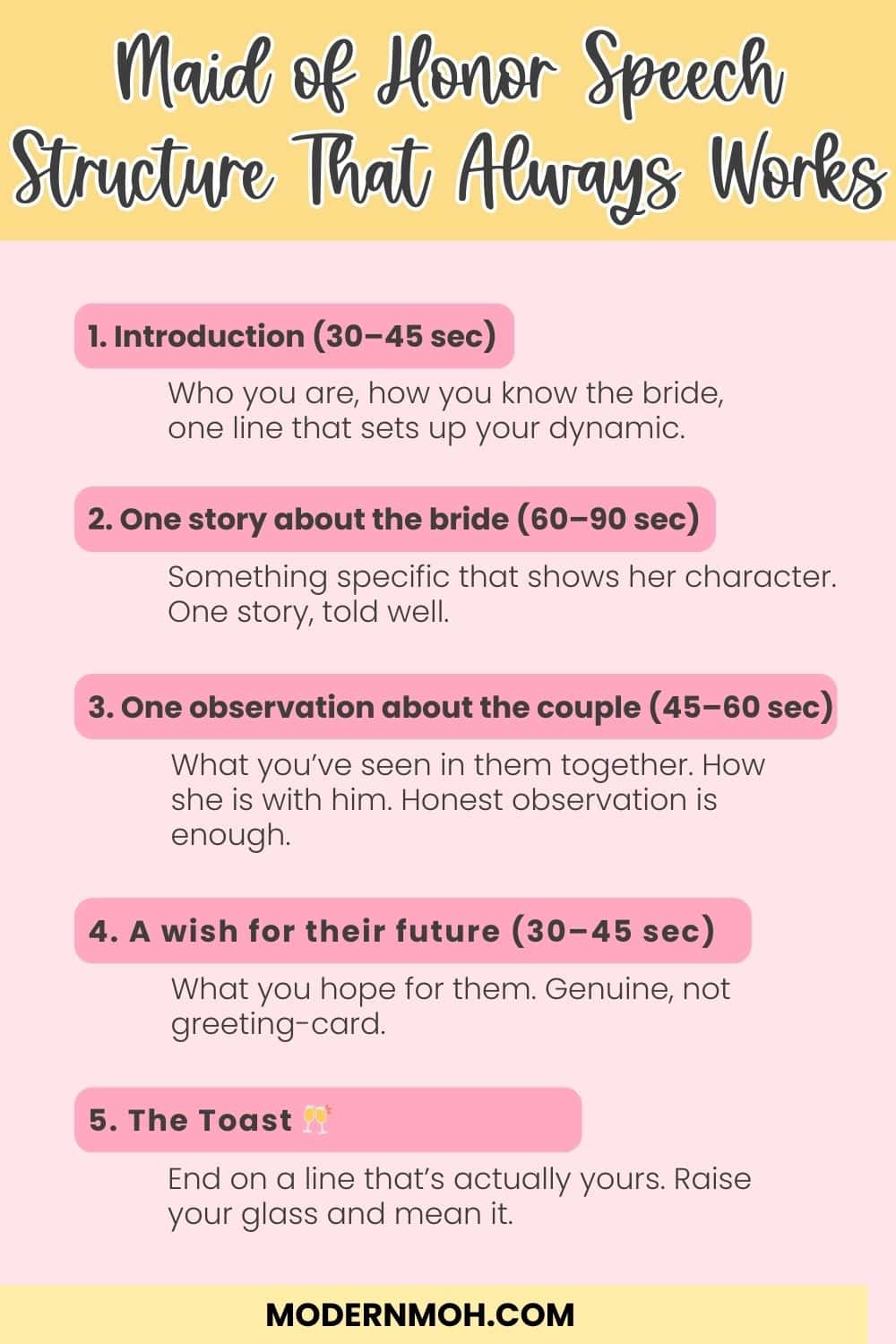
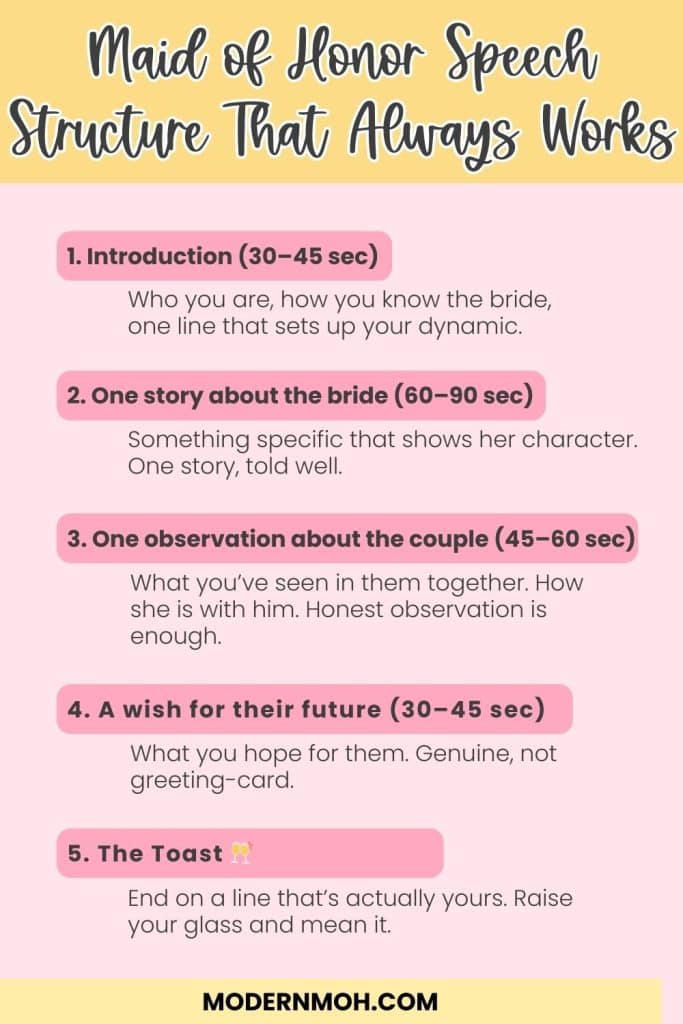
If you’re still putting the actual speech together, this is the MOH speech structure that consistently lands well. It’s funny enough to get laughs, sincere enough to get tears, and focused enough that nobody checks their watch.
1. Introduction (30–45 seconds) Who you are, how you know the bride, one line that establishes your dynamic. Keep it light.
2. One story about the bride (60–90 seconds) Choose something specific, warm, and revealing of her character. Not a list of memories, just one story, told well.
3. One observation about the couple (45–60 seconds) What you’ve seen in them together. How she is with him. What changed in her when he came around. This doesn’t require a deep personal history with the groom, honest observation is enough.
4. A wish for their future (30–45 seconds) What you hope for them. What you know they’ll build. Keep it genuine, not greeting-card.
5. The toast Raise your glass. End on a line that’s actually yours, not something Googled at the last minute. If you find a quote that’s genuinely perfect, use it. But a real sentence from you will almost always land better.
That’s it. Four to six minutes, well-practiced, spoken like you mean it. That’s the kind of speech people remember.
Common Maid of Honor Speech Mistakes By Situation
If you’re her sister: You have decades of material, which is both a gift and a trap. Resist the urge to make it a childhood highlight reel. One or two stories about growing up together are beautiful, a chronological rundown from ages 5 to 25 is not. Choose the memories that connect to who she is now.
If you just met the groom recently: No need to fake a connection you don’t have. Talk about what you’ve noticed. How does he treat her? What’s different about her since he came into the picture? People can tell when you’re forcing it, and honest observation lands better every time.
If their relationship had real hardships: Acknowledging challenges can be powerful. But only if the couple has made peace with them. And only if you know they’re comfortable with you mentioning it. When in doubt, leave it out. Bringing up old pain without permission is a risk no speech is worth taking.
If you’re nervous about length: Three to five minutes is the ideal maid of honor speech length. Under that and it can feel like you didn’t try. Over eight minutes and you start losing the room regardless of how good the material is. Practice out loud, time yourself, and account for pauses – laughter and emotion always add more time than you expect.
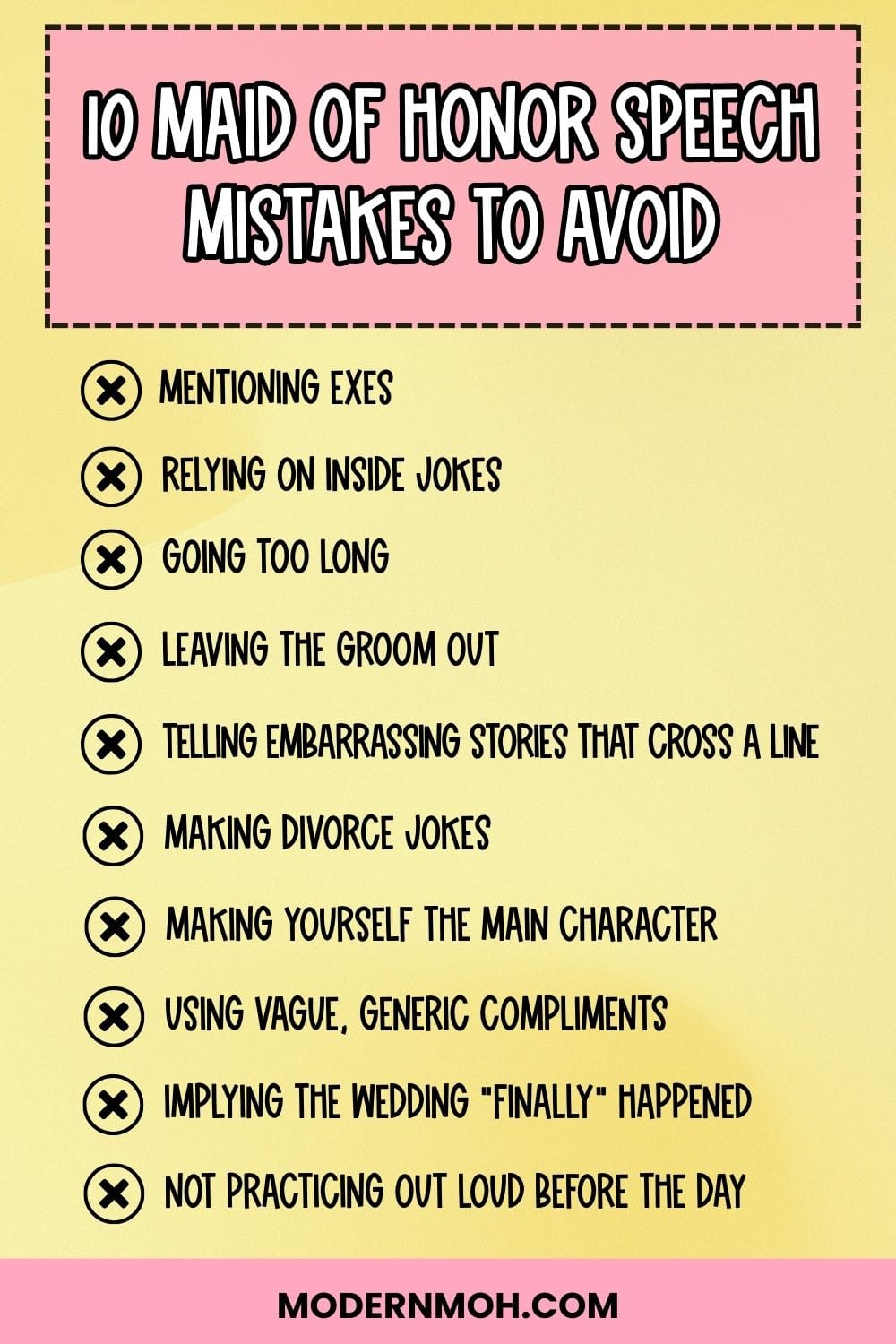
10 Maid of Honor Speech Mistakes to Avoid
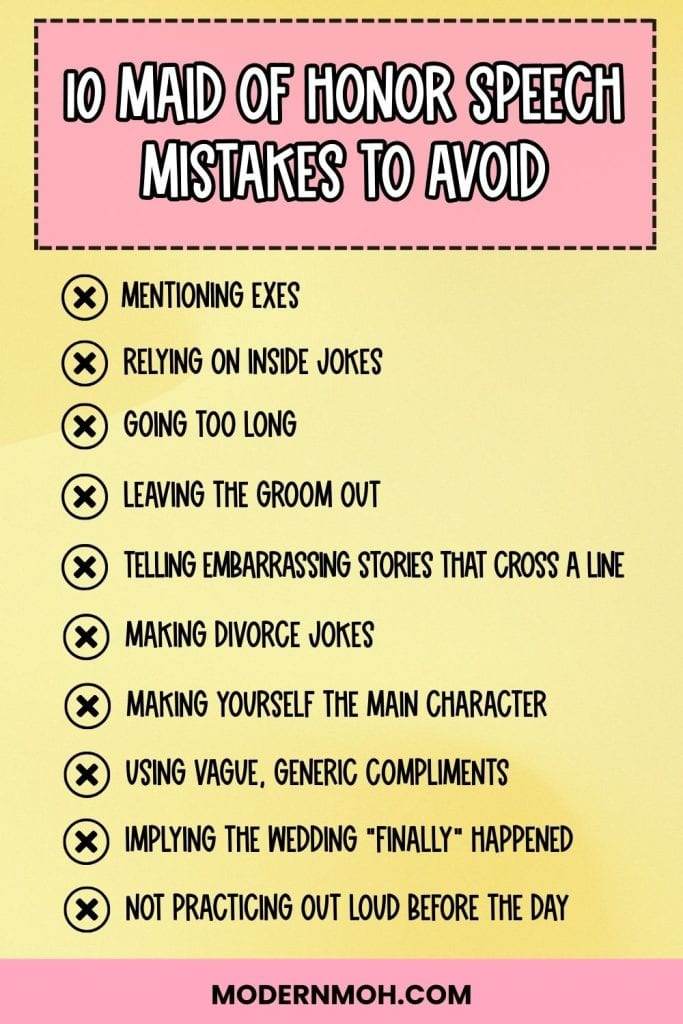
If you want the quick version, here are the ten things that sink an otherwise good speech:
- Mentioning exes
- Relying on inside jokes
- Going too long
- Leaving the groom out
- Telling embarrassing stories that cross a line
- Making divorce jokes
- Making yourself the main character
- Using vague, generic compliments
- Implying the wedding “finally” happened
- Not practicing out loud before the day
Any one of these can derail a great speech. More than one, and you’re the story someone’s telling at the after-party.
Bad vs. Good Maid of Honor Speech Example
Sometimes it’s easier to see the difference than describe it. Here’s the same moment written two ways.
Bad: “I’ve known Sarah through three boyfriends, two terrible apartments, and more bad decisions than I can count. Honestly I wasn’t sure this day was ever coming, but here we are!”
The problems: mentions relationship history, implies the wedding was overdue, makes a joke at the couple’s expense. The room gives that awkward half-laugh that tells you it didn’t land.
Better: “I’ve watched Sarah grow into someone who knows exactly what she deserves, and she found that in James. Watching them together, it’s obvious. She’s calmer, happier, and somehow even funnier than before, which I didn’t think was possible.”
Same affection. Zero landmines. The room actually feels something.
Before You Finalize: A Maid of Honor Speech Don’ts Checklist
Run through these speech tips and checklist before you consider your speech done:
If every box is checked, you’re ready.
Frequently Asked Questions
What is the biggest mistake in a maid of honor speech?
The single most common mistake is making the speech primarily about your friendship with the bride while barely acknowledging the groom or the marriage itself. A close second is including inside jokes that leave most of the room completely lost. Both mistakes come from the same place – focusing on what feels meaningful to you instead of what serves the couple and the moment. The fix is the same for both: zoom out, include the whole room, and remember what you’re actually there to celebrate.
Is it okay to be funny in a maid of honor speech?
Yes. Actually, please do. A speech that gets genuine laughs and then brings a tear to someone’s eye is the gold standard. The key is that the humor celebrates rather than embarrasses. Funny observations about the relationship, light moments from a shared memory, or a well-placed self-deprecating line all work. What doesn’t: jokes about exes, divorce, or anything that makes the couple look bad in front of two hundred people.
How personal is too personal?
Simple filter: if you’d be comfortable with the bride’s grandmother, her boss, and a room full of people she barely knows all hearing it, it belongs in the speech. If it needs a preface like “okay so you have to know her to appreciate this,” save it for brunch the next day.
Do I have to talk about the groom if I barely know him?
You don’t need to pretend you have a deep friendship with him. What you can always talk about is what you’ve observed: how he treats her, how she lights up around him, the version of herself she’s become in this relationship. That kind of honest observation often lands better than forced anecdotes anyway.
How do I end the speech without sounding generic?
A toast in your own words almost always beats a borrowed quote, unless the quote is genuinely perfect and your own words feel thin next to it. If you’re writing your own ending, keep the final lines focused on the couple’s future together: what you hope for them, what you see in them, the kind of life you know they’re going to build. Then raise your glass and actually mean it.
The Bottom Line
A great maid of honor speech is one of those rare moments where someone feels genuinely seen. Not just celebrated, actually understood. You have that ability. Leave the landmines on the cutting room floor, speak like yourself, and focus on the two people in front of you. That’s the kind of speech nobody forgets.
Pin for Later!
UP NEXT: 20 Questions to Help You Write Your Maid of Honor Speech