How to Structure a Maid of Honor Speech (5-part Template)
So you’ve been asked to give a maid of honor speech. You said yes, obviously. And now you’re staring at a blank document wondering how in the world you’re supposed to fill five minutes with something that makes people laugh, cry, and think that was the best speech I’ve ever heard — all at the same time.
Here’s the good news: a great maid of honor speech isn’t about talent. It’s about structure. Once you know what goes where, and roughly how long each piece should run, the writing gets a whole lot easier. The stories are already in your head, and this maid of honor speech structure just helps you put everything in the right order.
Whether you’re a natural storyteller or you genuinely cannot remember the last time you wrote more than a text message, this template on how to structure a maid of honor speech will carry you from the first word to the final toast.
Quick answer: What’s the best structure for a maid of honor speech?
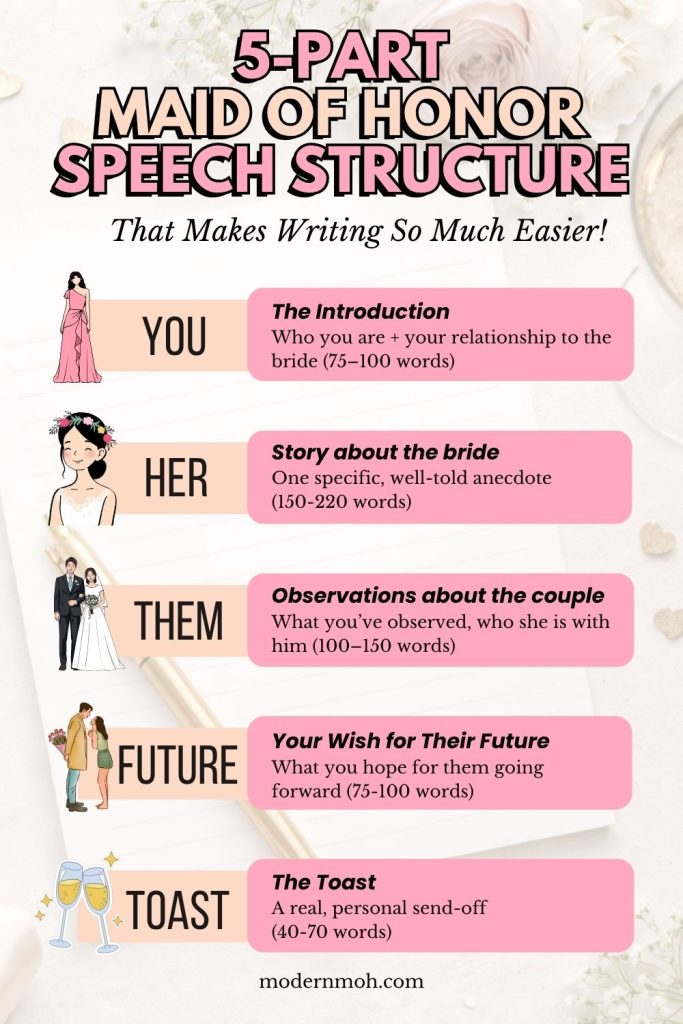
The best maid of honor speech structure is:
- Introduction
- One story about the bride
- Observations about the couple
- A wish for their future
- A toast
Most MOH speeches follow this 5-part format and run 4–6 minutes. Each section has a purpose. Skip any one of these and the speech usually feels off.
The 5-part Maid of Honor Speech Structure (simple outline template)
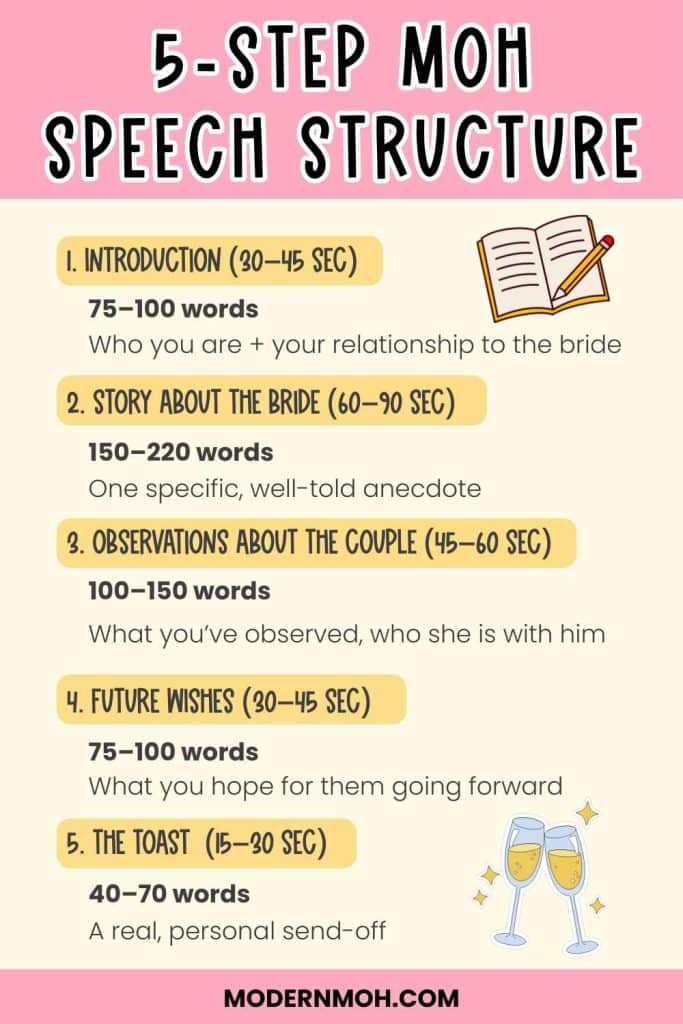
Part 1: The Introduction (30–45 seconds)
Your opening has two jobs: tell the room who you are and give them a reason to pay attention. That’s it. You don’t need a jaw-dropping line. You need to be warm, clear, and just interesting enough that people put down their bread rolls.
Start by introducing yourself – your name, your relationship to the bride, and one sentence that captures your dynamic. Something like: “I’m [name], and I’ve been [bride]’s best friend since the third grade, which means I have been waiting for this exact moment for about twenty years.” Short, specific, already a little funny. That’s the energy.
What you’re not doing: launching into a story before anyone knows who you are, opening with a nervous “um, so,” or starting with a joke that only the front table gets. Get the room on your side first.
⏱ Timing checkpoint: 30–45 seconds. If your intro is running over a minute, you’re already off track.
Part 2: One Story About the Bride (60–90 seconds)
This is the heart of the speech, and the most common place people go wrong. They try to squeeze in three stories, or they pick something so niche that half the room has no idea what’s happening.
Pick one story and make that one count.
The best MOH speech stories are specific, reveal something true about the bride’s character, and have enough context that a stranger could follow along. You’re not recapping your entire friendship, you’re choosing the one moment that says this is who she is.
Not sure if your story is appropriate? Here’s a quick good story checklist:
- Does it show something specific about her personality?
- Can you tell it in under 90 seconds?
- Would her grandmother and her coworker both find it either funny or touching?
- Does it connect to who she is now, not just who she was in college?
If yes on all four, you’ve got your story. If you’re her sister and have decades of material, literally, resist the highlight reel instinct. One great story beats five decent ones every single time.
For more on picking the right anecdotes, check out our 20 Questions to Help You Write Your Maid of Honor Speech.
⏱ Timing checkpoint: 60–90 seconds. If your story is hitting two minutes, edit it. Find where it starts getting good and cut everything before that.
Part 3: Observations About The Couple (45–60 seconds)
This is where a lot of otherwise good speeches start to wobble. The MOH spends three minutes talking about her friendship with the bride, throws in one sentence about the groom, and moves straight to the toast. Don’t do that. The whole point of this speech is to celebrate a marriage, which means the couple needs their own moment.
This section doesn’t require a deep personal relationship with the groom. What it requires is honest observation. What have you noticed about them together? How does he treat her? What’s different about her since he came into her life?
Some things that work:
- A specific moment you witnessed between them that said everything
- How she talked about him before you’d even met him
- Who she’s become since they’ve been together
- The thing about their dynamic that makes you genuinely happy for her
Where this usually goes wrong: generic praise like “he makes her so happy” with nothing to back it up. Go one layer deeper. He makes her so happy is the observation – the story or detail underneath it is what lands. (If you barely know the groom, our What Not to Say in a Maid of Honor Speech article covers exactly how to handle that without forcing it.)
⏱ Timing checkpoint: 45–60 seconds. This is where the speech naturally shifts from “let me tell you about her” to “let me tell you about them.”
Part 4: Your Wish for Their Future (30–45 seconds)
This is where you bring it home. The room has laughed (hopefully), maybe gotten a little misty, and now you’re bringing it home. This section moves from storytelling into something more forward-looking: what you hope for them, what you see in them, the kind of future you know they’re going to build.
Keep it genuine and specific. “I know they’re going to be incredible” is fine. “I know they’re going to figure it out together, the same way they’ve figured out everything else – with patience, bad jokes, and probably a lot of takeout” is better. The more specific, the more it sounds like you.
This is also where you can acknowledge any real meaning. If this friendship has carried you through something, if this relationship changed the way you think about love, if you’ve watched her become someone new, mention it here. Not heavy, just honest.
⏱ Timing checkpoint: 30–45 seconds. You’re winding down, not opening a new chapter.
Part 5: The Toast (15–30 seconds)
Raise your glass, look at the couple, and end on something real.
Write your own toast if you have the right words. A genuine line that’s actually yours will almost always land better than something borrowed. But if you’ve searched for the perfect MOH speech quote and genuinely found it, use it. The test isn’t whether it’s original, it’s whether it means something.
What to avoid: the generic “to the bride and groom!” closer that sounds like you ran out of steam. Your last line is the one people remember. Make it count.
⏱ Timing checkpoint: 15–30 seconds, then raise the glass.
Maid of Honor Speech Structure at a Glance
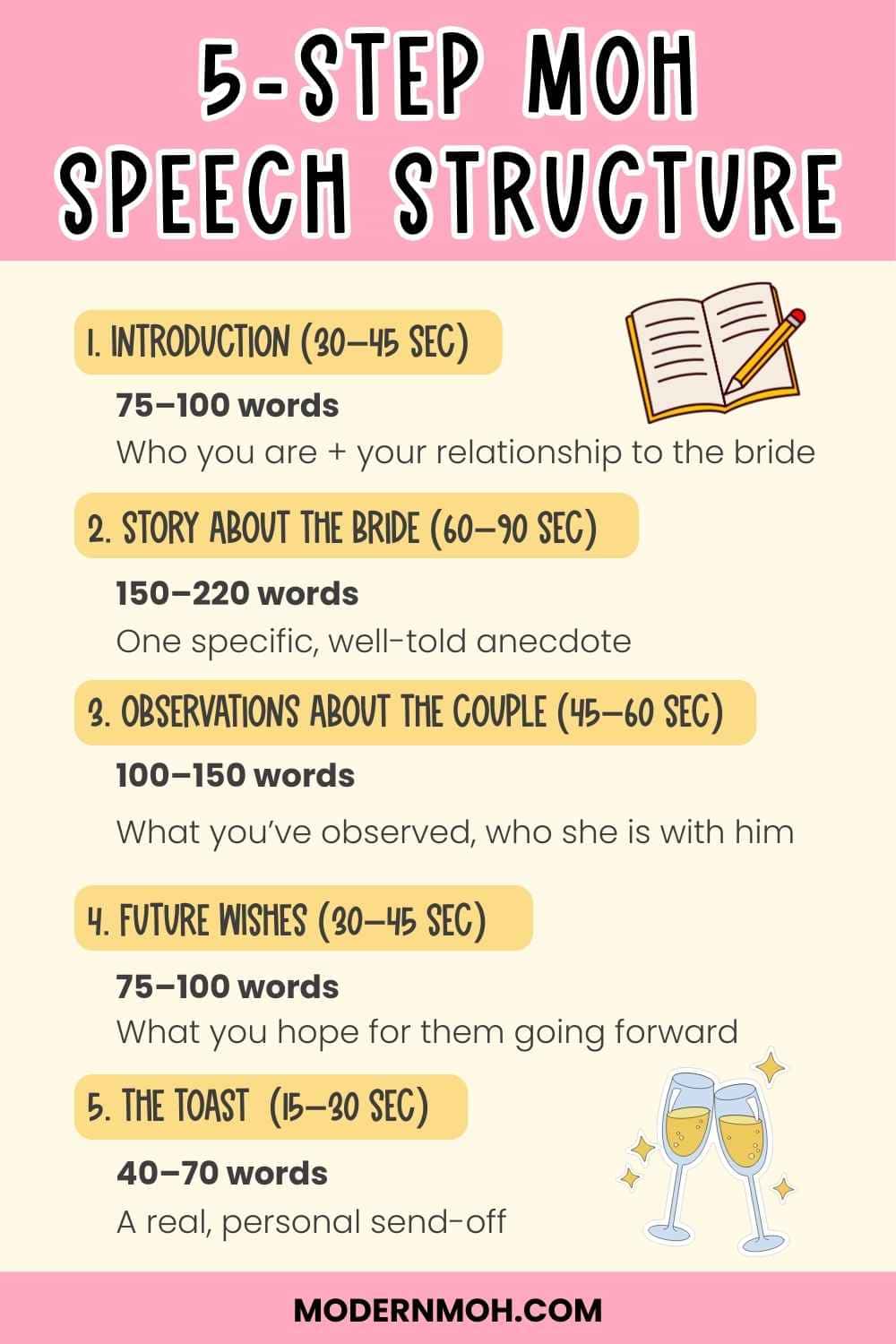
| Section | What it covers | Timing | Approx. word count |
|---|---|---|---|
| Introduction | Who you are + your relationship to the bride | 30–45 sec | 75–100 words |
| Story about the bride | One specific, well-told anecdote | 60–90 sec | 150–220 words |
| The couple | What you’ve observed, who she is with him | 45–60 sec | 100–150 words |
| Wish for the future | What you hope for them going forward | 30–45 sec | 75–100 words |
| The toast | A real, personal send-off | 15–30 sec | 40–70 words |
| Total | 4–6 minutes | 450–700 words |
One thing most people forget to account for: laughter and emotion both add time. If your story is landing and the room is with you, there will be pauses you didn’t plan for. Practice with that in mind and don’t time yourself on a silent first read.
The Maid of Honor Speech Formula (easy way to remember)
If you want something simple to hold onto while you’re writing:
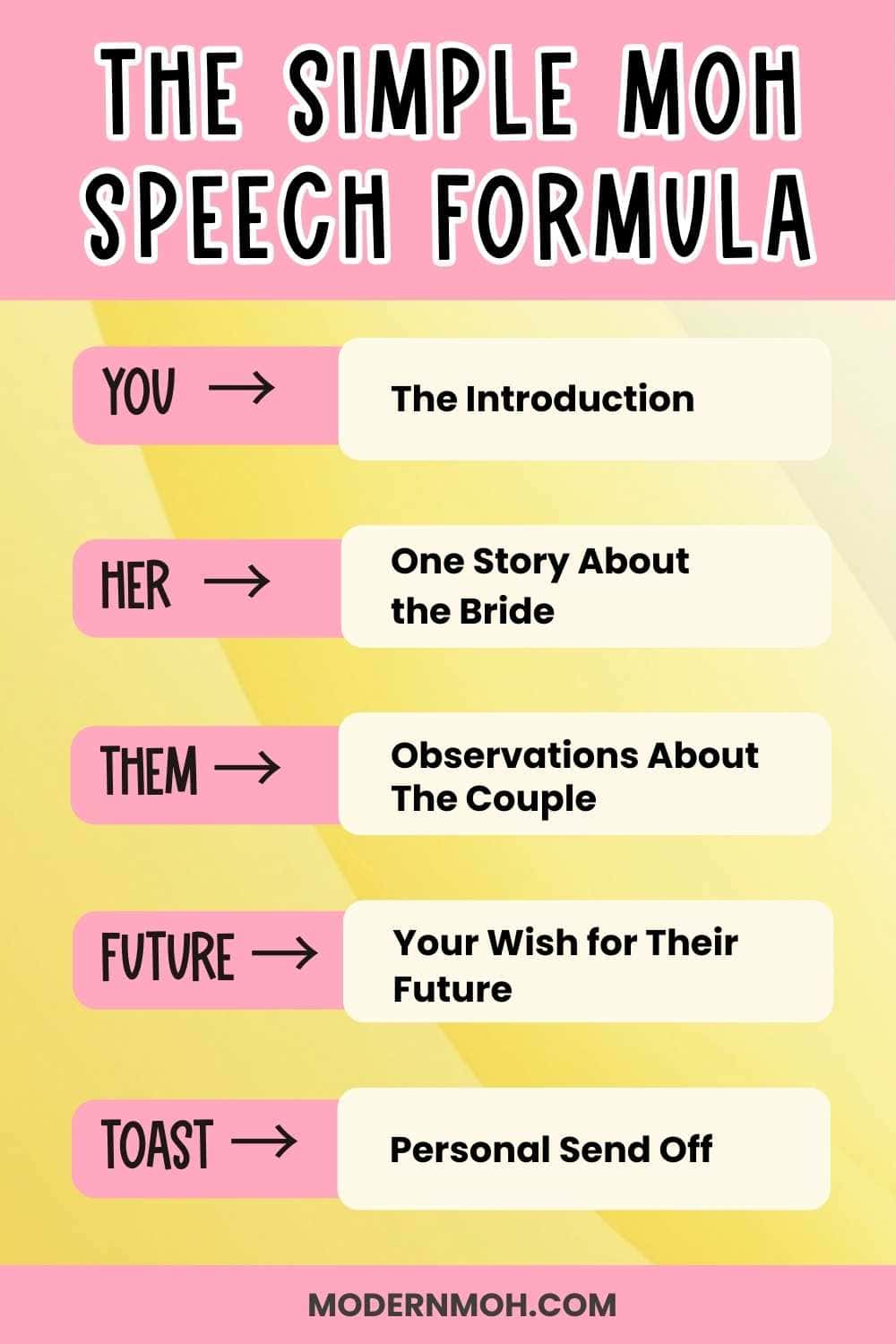
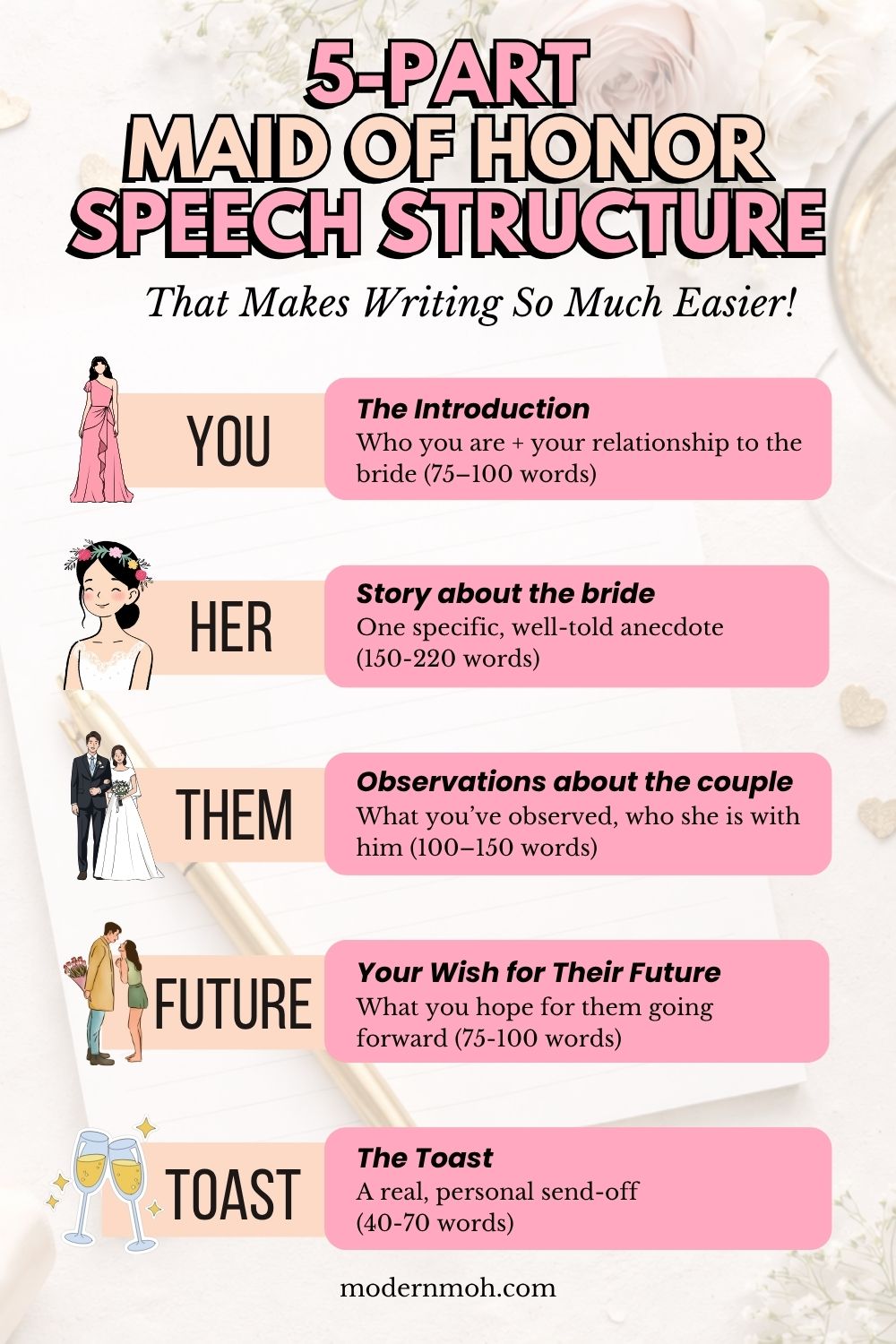
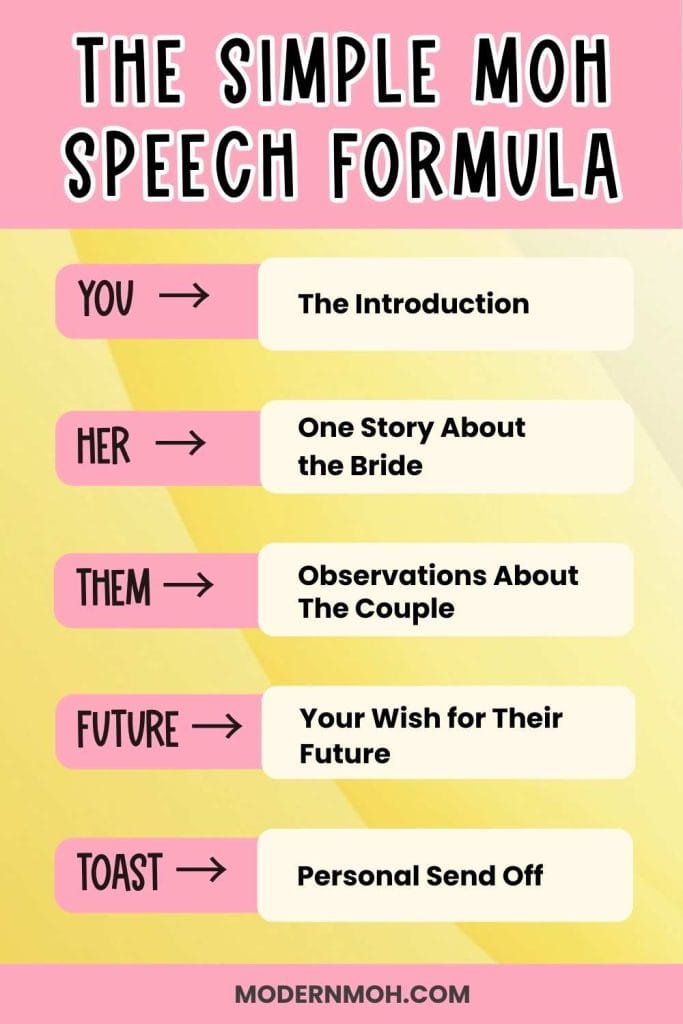
YOU → HER → THEM → FUTURE → TOAST
That’s the whole outline. Each step moves the focus outward — from who you are, to who she is, to who they are together, to where they’re going. If you’re writing your speech right now, save this or screenshot it. Most MOHs end up coming back to it.
What a Well-structured Speech Actually Sounds Like
Reading about structure is one thing. Seeing it in action is another. Here’s a short example using fictional names so you can see how the five parts actually fit together.
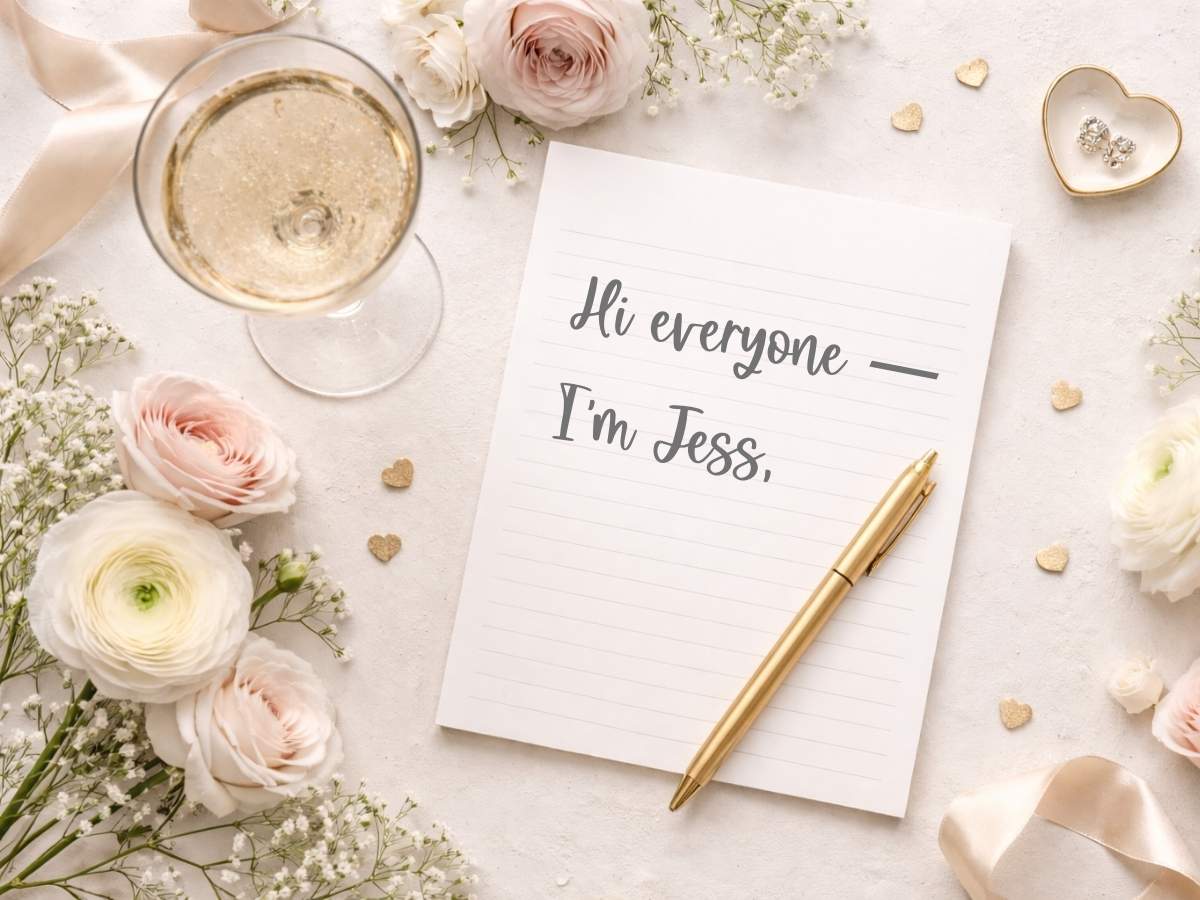
[INTRODUCTION] “Hi everyone — I’m Jess, and I’ve been Maya’s best friend since we were assigned to the same dorm room freshman year. She cried at the move-in. I did not tell her that I also cried, in the car, on the way there.
[BRIDE STORY] There’s one story that I think captures Maya better than anything else I could say up here. About four years ago, she drove three hours in the middle of a snowstorm to help me move out of a situation I should have left a lot sooner. She didn’t ask questions. She showed up with her car, a bad playlist, and a very strong opinion about which boxes were worth keeping. That’s Maya. She doesn’t wait to be asked twice, and she never makes you feel like you owe her for it.
[THE COUPLE] And then she met Daniel. I’ll be honest — I was skeptical at first, the way you’re always a little skeptical when your best friend starts spending less time answering your texts. But then I actually watched them together. He listens to her the way people listen to someone they genuinely find interesting, not just someone they love. And she’s — she’s calmer. Still completely chaotic, but in a good way. The best way.
[FUTURE WISH] I don’t know exactly what’s ahead for you two. But I know you’re both the kind of people who show up for each other — in snowstorms, in hard seasons, in all of it. That’s not something you can fake, and it’s not something everyone gets.[TOAST] Daniel and Maya — may every chapter ahead be better than the last. To the bride and groom.”
Notice how each section leads naturally into the next one. This speech runs roughly two minutes as delivered, so shorter than you would want it, but gives an idea of flow.
Where Most MOH Speeches Go Off the Rails
- Too much intro, not enough story. Some MOHs spend 90 seconds on their own background before getting anywhere near the bride. The room wants to hear about the couple, so get there faster!
- The story goes sideways. A story that needs a three-sentence setup, or one that only the bride will find funny, breaks the room’s momentum. If you’re explaining why something is funny, the joke is already gone.
- The groom disappears. It’s easy to spend four minutes on your friendship and one sentence on the person she’s literally marrying. He’s standing right there. Give the couple their moment.
- The ending runs out of gas. Saving your best material for earlier and coasting to the finish. Your last line should feel intentional, not like you just ran out of things to say.
Inside jokes. We know. We know how good they are. Save them for the bachelorette.
RELATED POST: The Dos and Don’ts of Giving a Maid of Honor Speech
| Structure mistake | Why it hurts |
|---|---|
| Long intro | Guests lose interest before the good stuff starts |
| Multiple stories | Speech feels scattered instead of focused |
| No groom mention | Feels incomplete, he’s literally right there |
| Weak ending | Speech fades out instead of landing |
| Inside jokes | Leaves most of the room watching their appetizers |
Maid of Honor Speech Template (fill-in-the-blank framework)
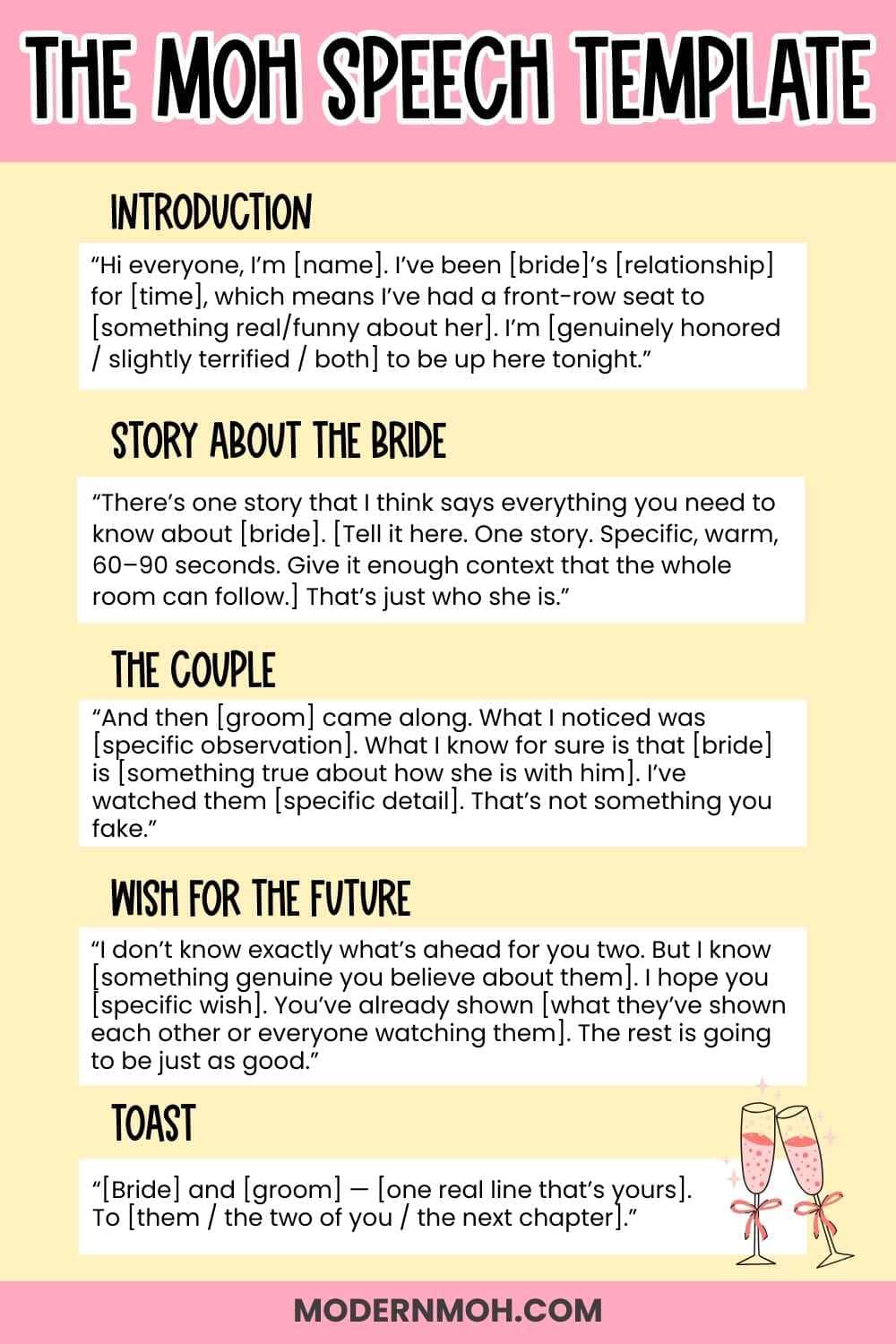
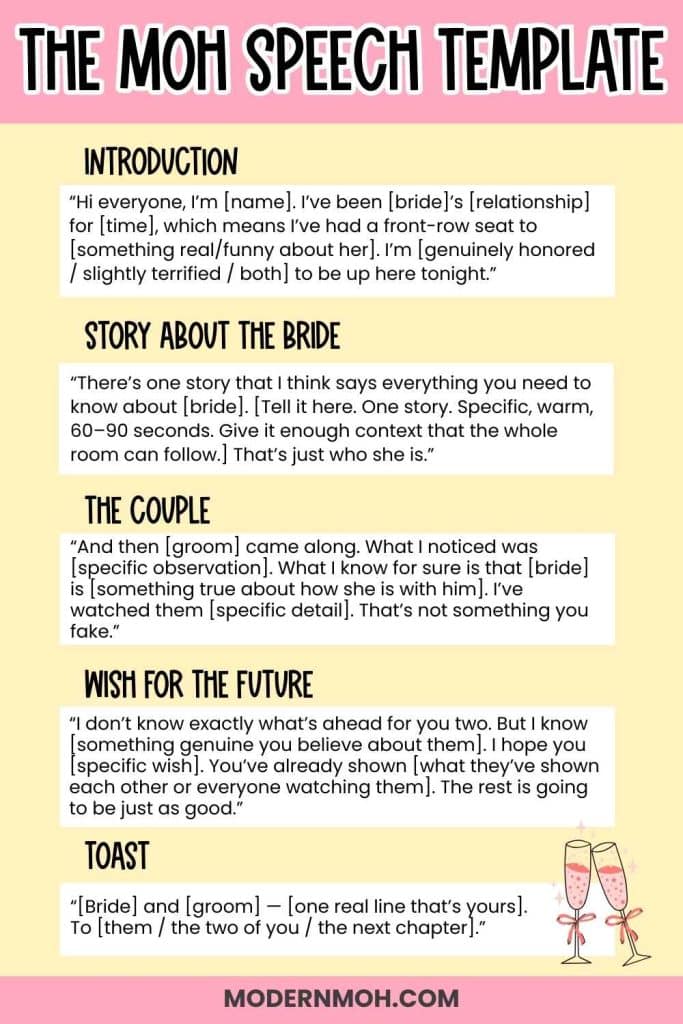
This isn’t a script. Think of it more like a framework. You can use it to get started, then make it sound like you. If you’re writing your speech right now, save this or screenshot it. This is the format a lot of maids of honor end up using when they start writing.
INTRODUCTION
“Hi everyone, I’m [name]. I’ve been [bride]’s [relationship] for [time], which means I’ve had a front-row seat to [something real/funny about her]. I’m [genuinely honored / slightly terrified / both] to be up here tonight.”
STORY ABOUT THE BRIDE
“There’s one story that I think says everything you need to know about [bride]. [Tell it here. One story. Specific, warm, 60–90 seconds. Give it enough context that the whole room can follow.] That’s just who she is.”
THE COUPLE
“And then [groom] came along. What I noticed was [specific observation]. What I know for sure is that [bride] is [something true about how she is with him]. I’ve watched them [specific detail]. That’s not something you fake.”
WISH FOR THE FUTURE
“I don’t know exactly what’s ahead for you two. But I know [something genuine you believe about them]. I hope you [specific wish]. You’ve already shown [what they’ve shown each other or everyone watching them]. The rest is going to be just as good.”
TOAST
“[Bride] and [groom] — [one real line that’s yours]. To [them / the two of you / the next chapter].”
What if Your Speech Doesn’t Fit This Structure?
What if I have two stories I can’t cut?
Pick the one that serves the couple better, not the one that’s funnier for you. If they’re genuinely equal, pull the strongest element from each and combine them into one tighter narrative rather than running them back to back.
What if I don’t have a great story?
You do. You’re just too close to see it. Answer this: what’s one moment that made you think this is exactly who she is? It doesn’t have to be dramatic. Small and specific beats big and vague every time.
What if their relationship had a complicated road?
Acknowledge it only if the couple has publicly made peace with it and you know they’re comfortable with it being mentioned. Otherwise, focus forward. The wedding day is about where they’re going, not everywhere they’ve been.
What if I’m her sister and we have a complicated relationship?
Keep it warm and honest without performing a closeness that doesn’t feel real. Audiences can tell the difference. “We didn’t always make it easy on each other, but I wouldn’t trade a single year of it” lands better than a speech that pretends everything was always perfect.
Before You Step Up To the Mic
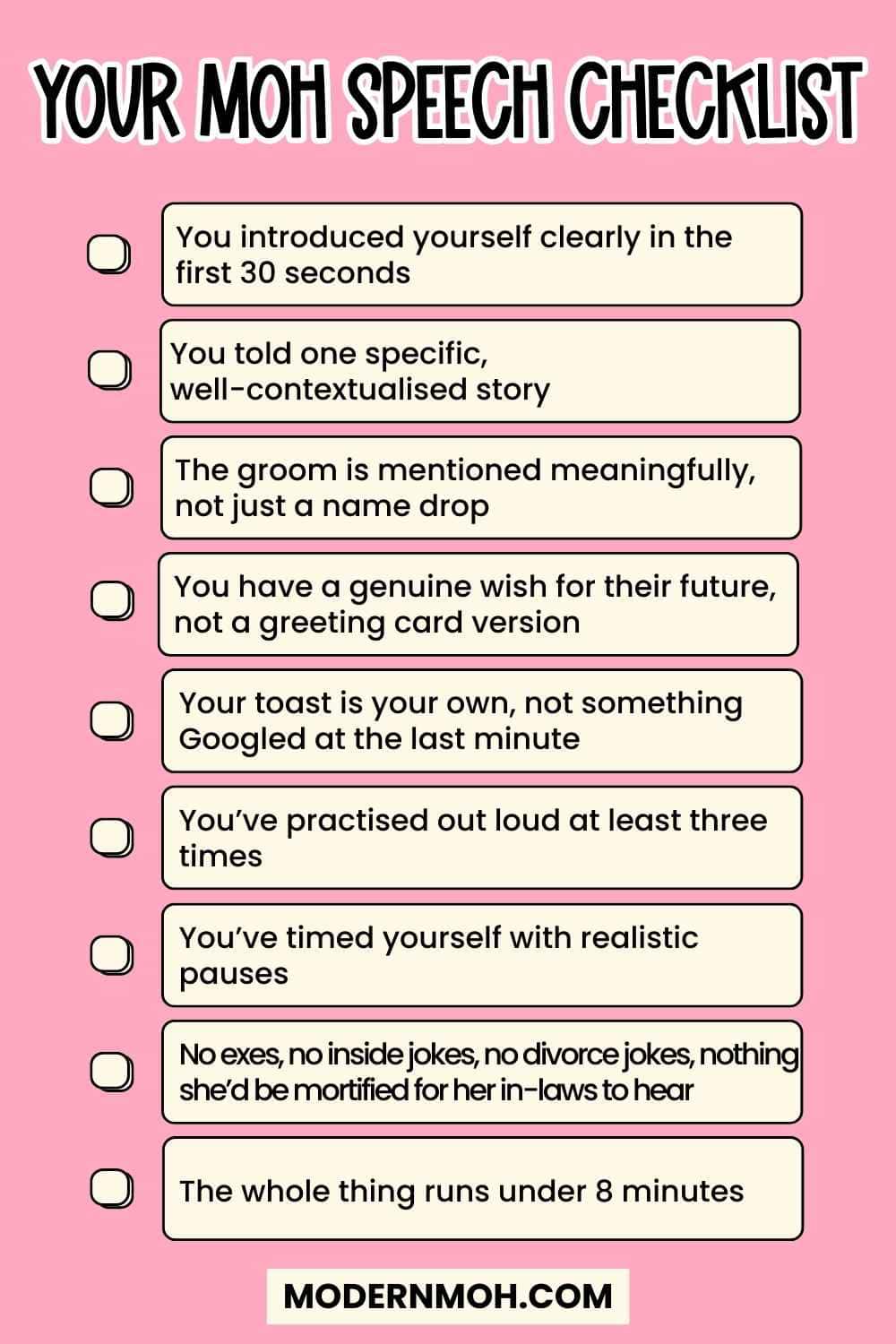
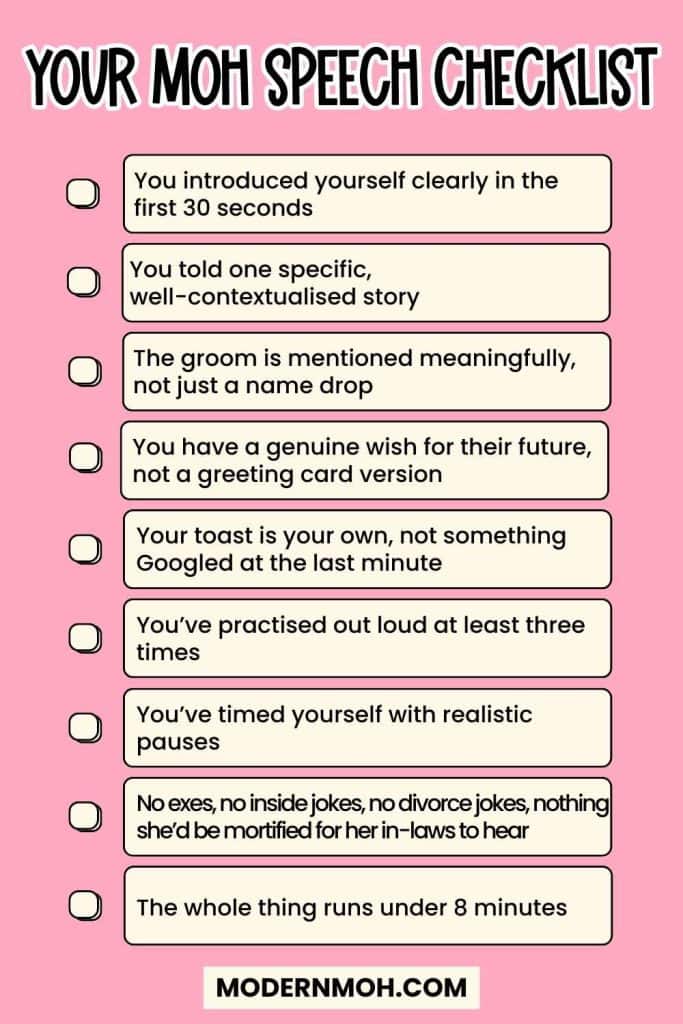
Before you give your MOH speech, here’s a quick checklist to make sure you’re show-ready!
Frequently Asked Questions
Do I have to follow this structure exactly?
No, but you should have a reason for every deviation. This outline works because each section has a specific purpose: ground the room, build connection, acknowledge the couple, close meaningfully. If you want to reorder things or blend sections, that’s fine, as long as the speech still moves clearly from beginning to middle to end. What you can’t skip: introducing yourself, mentioning the groom, and ending with a real toast.
How many parts should a maid of honor speech have?
Five is the number that consistently works: introduction, bride story, couple section, future wish, and toast. Some speeches combine the future wish and toast into one closing section, which is fine if the transition feels natural. Going below four parts usually means something important got cut. Going above five tends to make the speech feel like it’s stalling.
What order should a maid of honor speech follow?
The order matters more than most people realise. Start with yourself (so the room knows who’s talking), move to her (so they understand your friendship), then shift to them as a couple (so the speech acknowledges the marriage), then close with the future and the toast. That sequence builds naturally to the ending.
How do I make transitions between sections feel natural?
Don’t announce them. You don’t need “and now I want to talk about the couple.” A natural bridge works better — something that flows out of the story. For example: “That’s [bride] in one story. And then she met [groom], and I watched her [something specific], and I thought — oh, okay. This is it.” The section change happens inside the narrative, not outside it.
Should I memorize my speech or read from notes?
Read from notes. The risk of blanking mid-speech in front of a hundred people is not worth the performance points you’d gain from going off-book. Print it in a large, easy-to-read font, practice enough that you’re mostly looking up at the room, and give yourself permission to glance down. Nobody is judging the notes. They’re judging the speech.
What’s the best way to practice?
Out loud, in full, at least three times before the day. Once alone to get the words into your body. Once in front of someone who doesn’t know the bride, so they can tell you whether the stories land for strangers. Once more with realistic timing. The version in your head and the version coming out of your mouth are completely different experiences. The only way to close that gap is to say it out loud.
How early should I start writing?
Give yourself at least two to three weeks. The first draft is always rougher than you expect, and you’ll want time to sit with it, edit it, and practice without feeling rushed. Starting the night before never ends well.
The Bottom Line: How to Structure a Maid of Honor Speech
A great maid of honor speech isn’t a performance, it’s a gift. You’re giving the couple a moment they’ll remember for the rest of their lives, in front of everyone who matters to them. That’s a big deal, and you already have everything you need to pull it off.
Stick to this maid of honor speech structure, make it specific, and say it like you mean it. You already have the stories, and now you know how to tell them!
Pin for Later!
UP NEXT: How Long Should a Maid of Honor Speech Be?